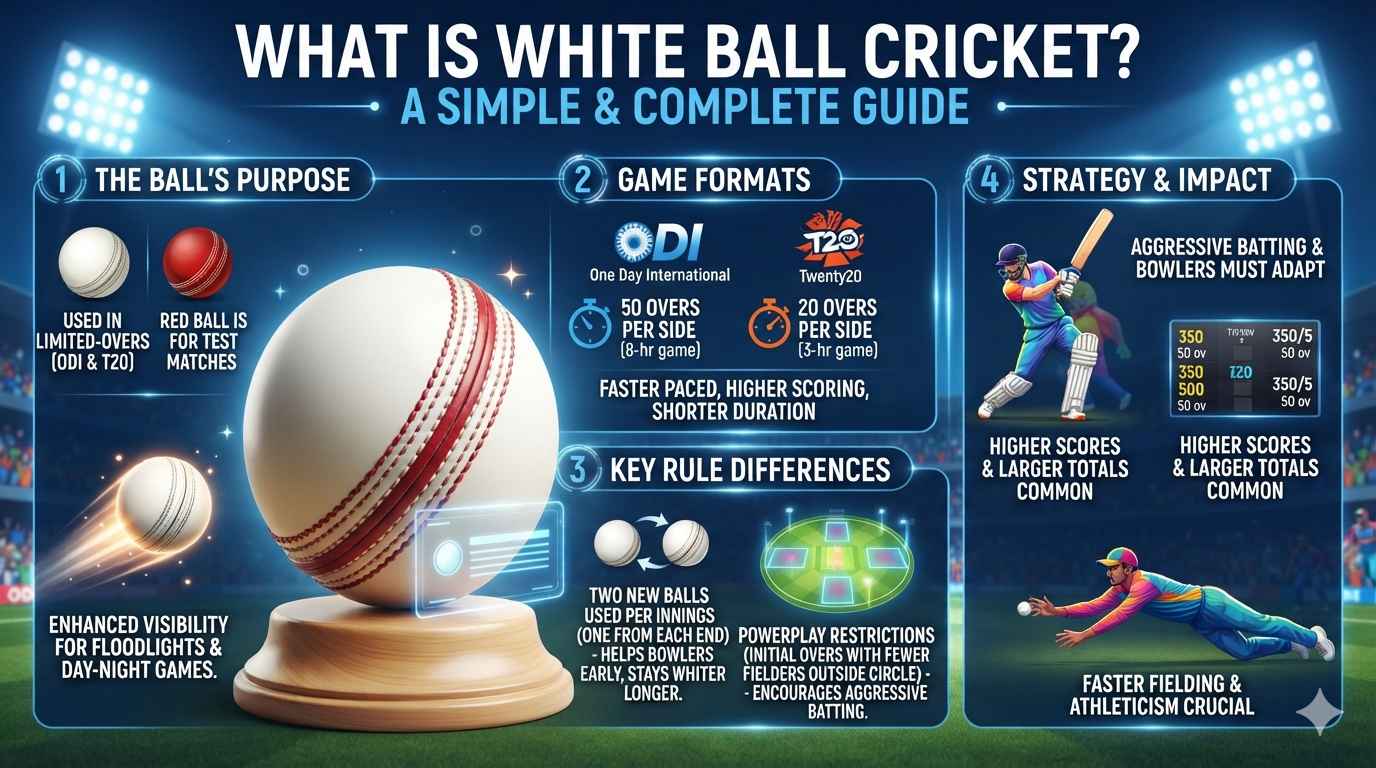
If you are new to the world of sports, you might wonder what white ball cricket actually means. Simply put, it refers to limited-overs cricket matches where players use a bright white leather ball instead of a traditional red one. These matches include One Day Internationals (ODIs) and Twenty20 (T20) games. White ball matches were designed to be faster, more colorful, and much more exciting for fans watching in stadiums or on television.
Unlike traditional matches that last for five days, a white ball cricket game finishes in a single day or just a few hours. To help the bright ball stand out, players wear colorful uniforms instead of traditional whites. This modern format brought a massive wave of energy, big hitting, and fast-paced strategy to the sport, making it popular across the globe.
White Ball Cricket Meaning Explained Simply
To understand the white ball cricket meaning, you just need to look at how limited-overs games are played. The term describes any official match where each team gets a fixed number of overs to bat, usually 20 or 50 overs. Because these games often continue into the evening under bright stadium floodlights, a traditional red ball would be very hard for batters and fans to see.
Switching to a white ball solves this visibility problem completely. So, when people discuss white ball cricket, they are talking about action-packed formats like T20s and ODIs. These matches feature power hitting, tight fielding, clever bowling variations, and dramatic finishes that keep fans on the edge of their seats from start to finish.
Red Ball vs White Ball Cricket: Key Differences
When comparing red ball vs white ball cricket, the biggest differences come down to time, strategy, gear, and ball behavior. Red ball matches, known as Test cricket, last up to five long days. Players wear traditional all-white clothing, and the game tests patience, stamina, and deep tactical skill over long sessions.
In contrast, white ball cricket is built for speed, entertainment, and fast decision-making. The white ball tends to swing more during the first few overs, but it quickly loses its shine and grows soft. This makes it easier for batters to hit huge sixes as the innings progresses. While Test cricket rewards patient defense, limited-overs games encourage aggressive scoring right from the very first ball.
| Feature | Red Ball Cricket | White Ball Cricket |
| Match Duration | Up to 5 Days | 3 to 8 Hours (Single Day) |
| Clothing | Traditional Whites | Colorful Team Jerseys |
| Primary Formats | Test Matches | ODIs and T20s |
| Ball Behavior | Swings longer, stays hard | Swings early, gets softer quickly |
| Main Focus | Patience and Defense | Fast Scoring and Power Hitting |
Why Was White Ball Cricket Introduced?
The birth of white ball cricket changed the sports world forever. Back in the late 1970s, cricket administrators wanted to make the sport more appealing to younger audiences and busy working families. Traditional five-day matches were often slow, and many games ended in draws without a winner.
By creating limited-overs formats with a white ball, organizers made the game faster and guaranteed a clear winner in every single match. The addition of colored clothing, music, floodlights, and aggressive batting turned standard matches into massive entertainment spectacles. Today, white ball cricket attracts millions of passionate viewers worldwide, filling stadiums and generating massive global interest.
How the White Ball Behaves During a Match
Understanding how the ball behaves is essential for anyone learning what is white ball cricket. A fresh white leather ball is coated with a special polyurethane lacquer to keep it bright and visible under floodlights. Because of this smooth coating, the brand-new ball often swings significantly through the air during the opening overs of an innings.
However, as the game moves forward, the ball scuffs up on the hard pitch and loses its shine much faster than a red ball. As it gets softer, it becomes harder for bowlers to swing it, giving batters a big advantage to play powerful shots. To counter this, clever bowlers use slower balls, wide yorkers, and cutter variations to trick batters in limited-overs matches.
Legendary Players with the Most Runs in White Ball Cricket
Over the decades, several legendary batters have mastered limited-overs formats through incredible skill and consistency. When looking at the record books for the most runs in white ball cricket, Indian legend Sachin Tendulkar leads the overall international chart with over 18,000 runs in ODI matches alone.
Modern icons like Virat Kohli have also dominated white ball cricket across both ODIs and T20 internationals, averaging phenomenal numbers while chasing down tough targets. These great players adapted their technique to beat changing field placements, score quick runs under immense pressure, and set unbelievable world records that inspire the next generation of young athletes.
Profiles of Top White Ball Legends
To appreciate the greatness in limited-overs formats, let us look at the key career statistics of iconic players who dominated white ball cricket on the international stage.
| Player Name | Country | Active Years | Key White Ball Format | Major Achievement |
| Sachin Tendulkar | India | 1989–2012 | ODI | All-time highest run-scorer in ODIs |
| Virat Kohli | India | 2008–Present | ODI & T20I | Fastest player to reach 13,000 ODI runs |
| Chris Gayle | West Indies | 1999–2021 | T20 & ODI | Most sixes in overall white ball formats |
| AB de Villiers | South Africa | 2004–2018 | ODI & T20I | Fastest ODI century (31 balls) |
Essential Rules of Limited-Overs Cricket
The rules of white ball cricket are specially crafted to keep the action fast and fair. Each team gets one innings to bat for a set number of overs, usually 20 or 50. To encourage attacking play, field restrictions called field restrictions or “powerplays” are placed during the early overs of the match.
During a powerplay, only a few fielders are allowed outside the inner circle, giving batters a great opportunity to hit over the infield for quick boundaries. Additionally, bowlers are restricted in how many overs they can bowl per match. If a bowler steps over the front crease, the umpire calls a no-ball, giving the batting team a penalty run and a free hit on the next delivery.
How White Ball Cricket Transformed Strategy
The rise of white ball cricket completely revolutionized how teams prepare, practice, and play the game. In the past, batters focused mainly on solid defensive technique and waiting patiently for bad balls. Today, players train extensively to execute innovative shots like ramp sweeps, reverse scoops, and massive switch hits.
Bowlers have also evolved rapidly to survive in white ball cricket. They no longer rely solely on basic line and length. Instead, modern bowlers master knuckleballs, back-of-the-hand slower balls, and deadly pinpoint yorkers at the death overs. Fitness levels have soared, and fielding has become a true art form where saving a single run can win a high-stakes tournament.
The Rise of Global T20 Leagues
The popularity of white ball cricket reached unprecedented heights with the creation of domestic T20 leagues around the world. Tournaments like the Indian Premier League (IPL), Big Bash League (BBL), and Caribbean Premier League (CPL) brought international stars together into franchise teams.
These leagues proved that white ball cricket is not just a popular sport, but a multi-billion-dollar global entertainment industry. Young players now have amazing platforms to showcase their talent to millions of fans. Franchise leagues have accelerated the development of new batting techniques and tactical innovations, forever changing how the game is played across every continent.
Coaching Tips to Excel in Limited-Overs Games
If you want to excel in white ball cricket, you must develop both physical skills and strong mental toughness. First, focus on mastering clear strike-rotation techniques. Hitting boundaries is fantastic, but consistently taking singles and doubles keeps the scoreboard moving smoothly and puts constant pressure on the opposition.
Second, practice specific situational skills during your net sessions. If you are a bowler, practice bowling yorkers at target markers repeatedly under fatigue. If you are a batter, work on clearing your front leg and hitting cleanly over the inner fielders. Mastering these key moments will make you a far more valuable team player in modern limited-overs formats.
Conclusion
In conclusion, white ball cricket has reshaped the sporting world by delivering non-stop excitement, innovation, and fast-paced drama. From understanding the core white ball cricket meaning to analyzing the classic debate of red ball vs white ball cricket, it is clear that limited-overs formats have brought millions of new fans to the sport. Whether you are tracking the most runs in white ball cricket or playing a local weekend match, this vibrant format offers endless joy.
What is your favorite moment in limited-overs history? Share your thoughts in the comments below, or send this article to a friend who is learning what is white ball cricket!
(FAQs)
1. What is white ball cricket?
It refers to limited-overs matches, such as ODIs and T20s, played with a white leather ball instead of a red one. Players wear colorful uniforms, and matches are completed in a single day.
2. What is the key difference in red ball vs white ball cricket?
Red ball cricket is played over five days in white clothes with an emphasis on defense and patience. White ball cricket consists of limited overs, colorful kits, fast scoring, and finishes in a few hours.
3. What is the true white ball cricket meaning for fans?
For fans, it means fast-paced entertainment, power hitting, floodlit stadiums, and guaranteed match results packed into a short time frame.
4. Who scored the most runs in white ball cricket history?
India’s Sachin Tendulkar holds the record for the most runs in ODI history, while modern players like Virat Kohli dominate across both ODIs and T20 internationals.
5. Why does the ball change color in limited-overs games?
A white ball is used because limited-overs matches are often played under bright stadium floodlights at night, where a traditional red ball is difficult for players to spot.
6. Can a white ball swing like a red ball?
Yes, a new white ball swings significantly during the first few overs. However, it scuffs up and loses its shine faster than a red ball, making it softer as the match goes on.